Table of Contents
Rabbitry Realities
 Some days are more fun than others.
Today is one of the “other” days.
There's a good reason why I count and check over all of my litters every couple of days.
We lost Maggie's harlequin baby.
The baby had no obvious sign of illness other than a bloated belly.
It's a real shame - she was very cute, and also very large.
Maggie now has just 5 left: the 3 tris, the broken tort, and the broken red.
DCD: Cancon X Andy

They were born March 12, so they are 3 1/2 weeks.
They are hopping about and exploring quite far as you can see from the video.
The neighbours don't seem to mind.
<html><iframe width=“560” height=“315” src=“https://www.youtube.com/embed/Uepx9IA1NiQ” frameborder=“0” allow=“accelerometer; autoplay; encrypted-media; gyroscope; picture-in-picture” allowfullscreen></iframe></html>
DCK: Choir X Cinder
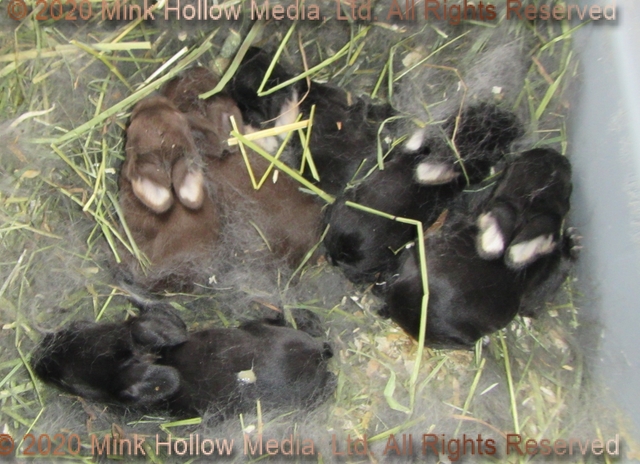
 Choir lost 3 of her babies including one of the chocolates. She's now down to 7 and compared to some of the other litters, hers don't look as healthy. Choir only weaned 4 of her 9 babies from her last litter, so I'm starting to wonder if maybe she's not a great mom. I've decided to foster off her two remaining chocolate babies to Cebreez, who only has four.
This is part of the reason that it is a good idea to breed your does so that some of them have their litters at the same time. Most of the time it is quite easy to foster baby rabbits to other moms, so long as they are fairly similar in age. All you need to do is just drop them in the other doe's nest box, and she will adopt them. Choir's babies are smaller than Cebreez's, but they are the same age, and it should be no problem for her to go from looking after four to looking after six. I'll keep you posted on their progress.
April 6 Update: The fostered babies have full bellies and seem fine. 
DCL: Cindy X Trigg
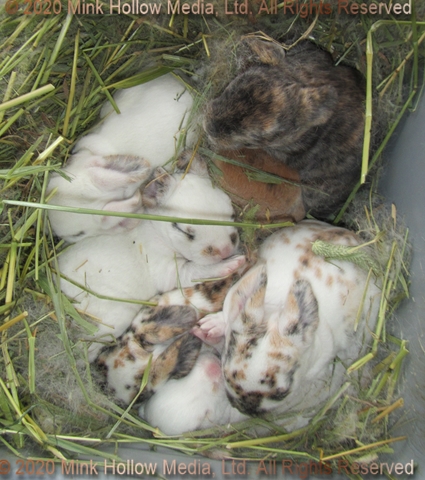
Cindy's babies are all big, fat, and healthy looking.
 |
 |
 |
<html><iframe width=“560” height=“315” src=“https://www.youtube.com/embed/ye6FuqziZwk” frameborder=“0” allow=“accelerometer; autoplay; encrypted-media; gyroscope; picture-in-picture” allowfullscreen></iframe></html>
DCM: Windy X Andy
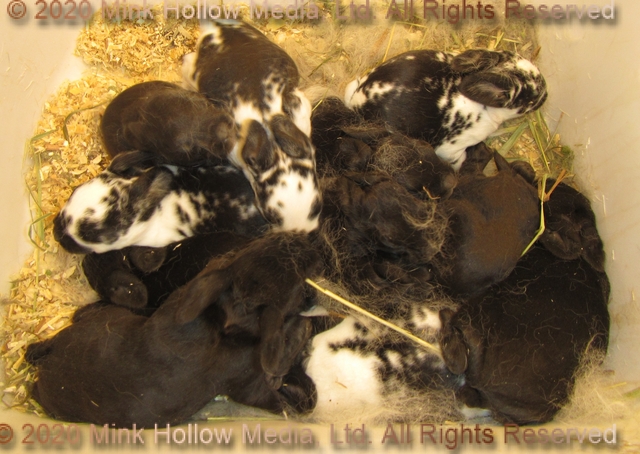
 Windy's babies, while small, also look pretty good. She still has 11.
<html><iframe width=“560” height=“315” src=“https://www.youtube.com/embed/YAeadvknMa0” frameborder=“0” allow=“accelerometer; autoplay; encrypted-media; gyroscope; picture-in-picture” allowfullscreen></iframe></html>
DCN: Tink X Atticus
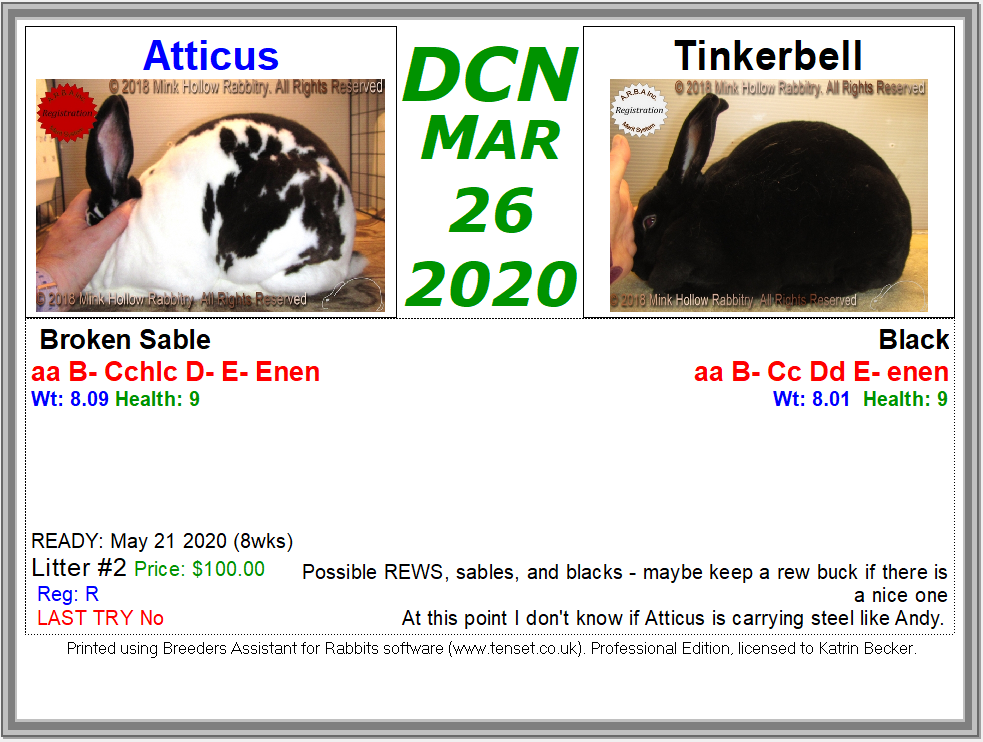 Tink lost ALL of her babies.
This is one of those things that people raising rabbits just have to get used to.
Even though we've all heard the idiom “breeding like rabbits”, the reality is not quite so simple.
Rabbits are what's called 'forced ovulators'. That means that they ovulate as a result of being bred. That also means that they can have another litter ANY time they are bred. In a natural setting it is advantageous for the MOTHER to survive so she can have another litter. That means that rabbits will sometimes let a litter die if they sense that they might not be able to raise the litter, either because of compromised health of the mother, or some perceived threat to the babies in the nest. Their overall chances of survival are better if mom effectively abandons the litter, gets pregnant again and then has a new litter, probably in a new nest.
Tink appears to be otherwise healthy, and she raised a litter of seven quite successfully at the start of the year. My plan is to move her to a different cage (in case she has some issue with her current one), and try again.
DCO: Cebreez & Chai
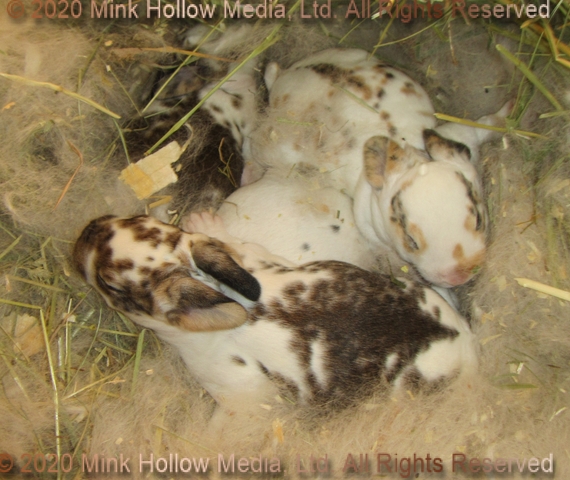
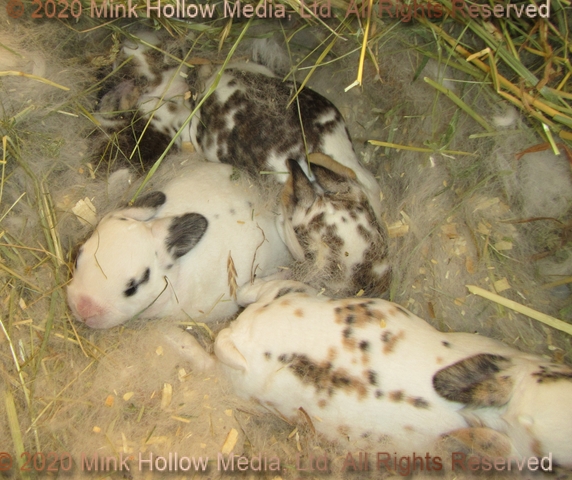
Cebreez, as you recall, only had 4.
They are very fat babies.
Cebreez is a large doe and appears to have planty of milk, which is why I decided to give her a couple of Choir's babies to look after.
 |
 |
 |
Two of Cebreez's babies are harlequinized broken castors.
The harlequin gene, also called the Japanese gene (“ej”) is a tricky one.
Many genes have a simple dominant or recessive relationship to the other genes in the same series.
A dominant gene is one whose effects can overshadow the effects of recessive genes.
The Japanese allele is not fully recessive to its dominant counterpart (“E” = full extension of hair colour).
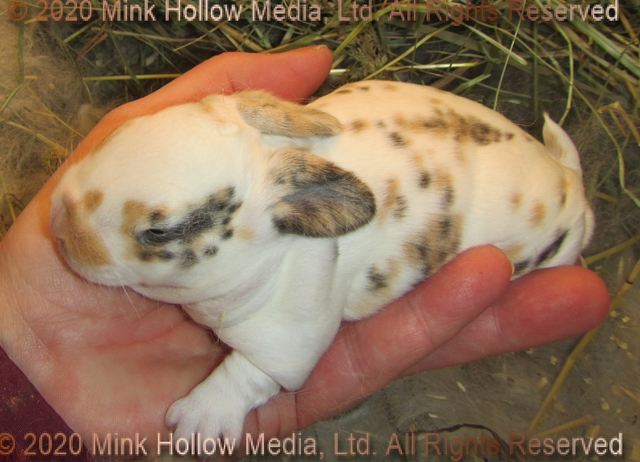
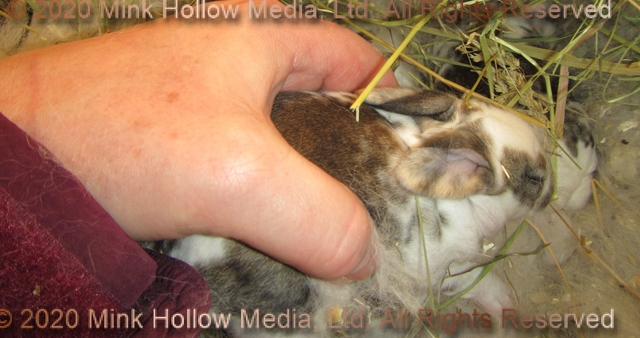
You can see the harlequin effect showing through when you look at the babies' ears. Instead of a clean lighter colouring inside the ears, we see a brindling effect.
That measn that these babies are carrying the Japanese gene and could produce tris, when bred to the right partner.
 |
 |
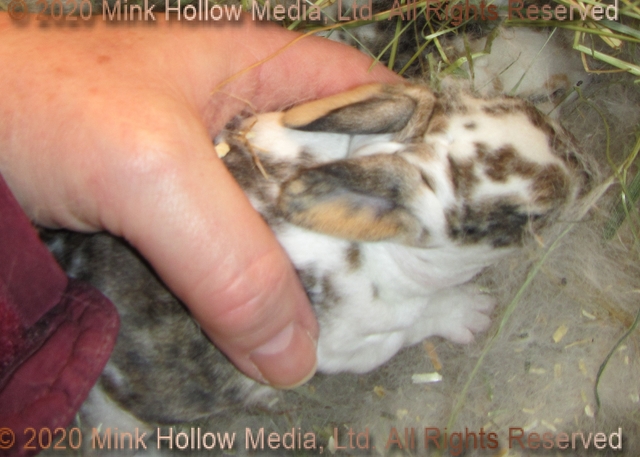 |
| This is the tri. In the coloured parts, you can see definite black spots and an orange background. |
This is one of the harle'd castors. The castor colour looks patchy but doesn't have the clearly defined black dots like the one on the left. |
This is another of the harle'd castors. Same here. You can clearly see the brindling in its ears. |
DCP: Conina X Buddy
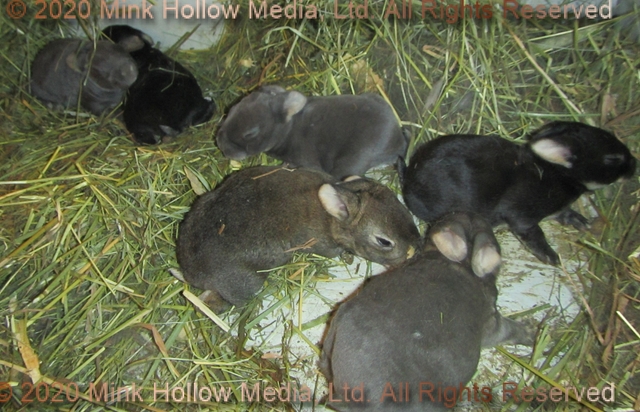
 Conina's babies are also pretty small compared to Cindy and Cebreez's. She also has only six. They are not staying in the nest mom made for them, and you can see that mom's housekeeping is not quite as good as, Cerise, for example.
As you can also see, their eyes are starting to open, ears too.
DCQ: Cerise X Comet
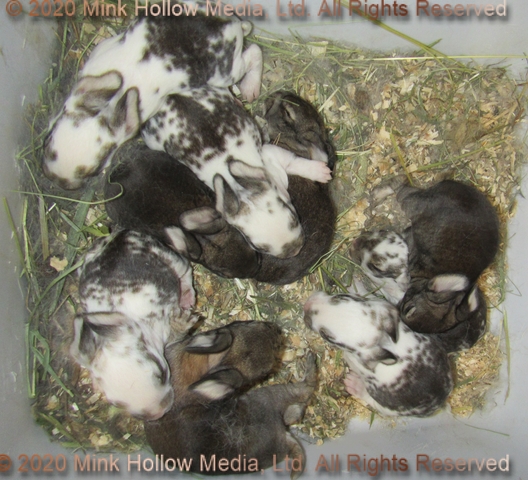

Cerise still has 9. She has not lost any in the last few days. If you recall, she started out with 11.
The nest is a really good one and the babies are snug and warm.
I took them out for the picture.
Can you tell what colours hers are?